
The Montessori Approach to Potty Learning: Tips for Families in Irving, TX
Quick Answer
Montessori potty learning in Irving is built on the same principles as every other area of our Montessori school: readiness, independence, and respect for your child’s natural pace. Our Montessori-trained guides do not work toward an arbitrary deadline. Instead, they observe your child carefully to support the process during their unique sensitive period for development. Within our prepared environment, the classroom is intentionally designed so your child can manage as much as possible on their own to foster autonomous discovery. And when home and school are using the same approach, the transition tends to go more smoothly than most families expect.
You’ve probably been wondering when to start
Potty learning is one of those milestones that comes with a lot of noise around it. Your pediatrician has a timeline. A parenting book says something different. And if you ask around, you’ll get a different answer from everyone. If you’re searching for a Montessori preschool in Irving, TX that has a clear, calm approach to this process, here’s what that actually looks like.
Why it’s called potty learning, not potty training
The language isn’t just a Montessori quirk. It reflects a real difference in approach. “Training” puts the adult in charge of the outcome. “Learning” puts your child there instead. According to Toileting the Montessori Way from the American Montessori Society, toileting is treated as a practical life skill that children are intrinsically motivated to develop when the conditions support them. The adult’s job is to set those conditions, not to push the process forward.
That reframe helps families too. When you stop treating potty learning as a task to complete by a certain date, it becomes a lot easier to follow your child’s cues and stay calm when progress doesn’t move in a straight line.
What your child’s Guide is actually watching for
Before any transition begins, your child’s Guide is observing. Not tracking. Not comparing. Just watching for the signs that your little one is genuinely ready: staying dry for longer stretches, noticing when they’re wet or uncomfortable, showing curiosity about the bathroom, and starting to develop the coordination needed to manage clothing independently.
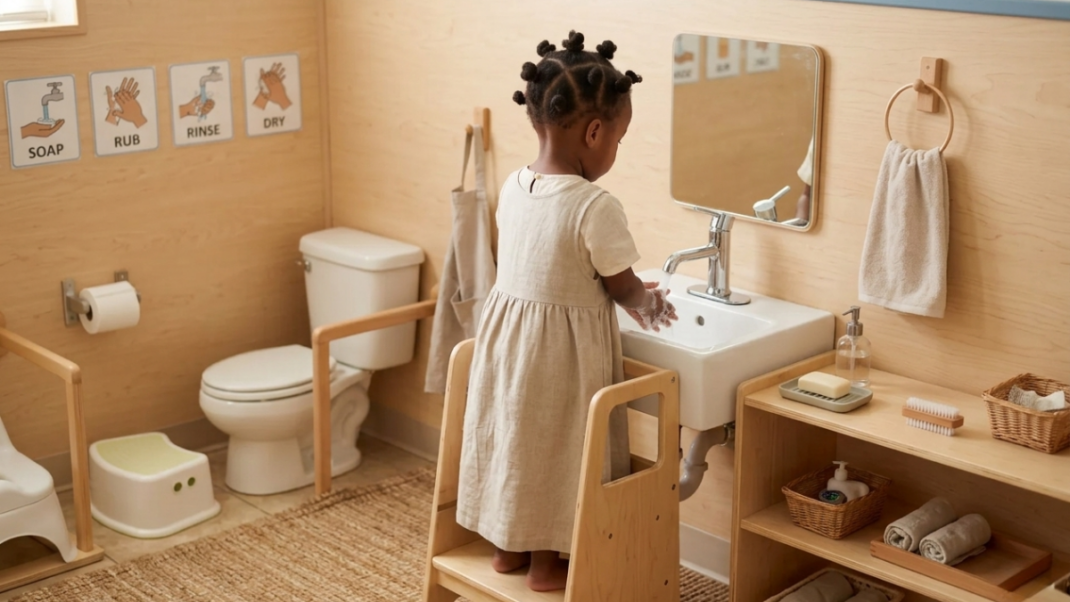
The classroom is built to support that process from the start. Low sinks. Accessible bathroom spaces. Step stools. Elastic-waisted clothing options. Everything is set up so your child can handle as many steps as possible on their own. The goal is for your child to feel inspired to learn in a self-directed approach guided by our Montessori teachers.
What it means when home and school are aligned
This is where families make the biggest difference. The American Montessori Society’s article A Montessori Approach to Toilet Training is clear about it: when adults in both places use the same calm language, respond to accidents the same way, and offer consistent opportunities throughout the day, children move through this process with more confidence and a lot less stress.
When you visit Rockbrook Montessori Academy, ask your child’s Guide how they facilitate the learning triangle between the child, the home, and the environment. A strong Montessori program has a clear process for this, and they genuinely want to know what’s already working at home. You’re not handing this off. You’re doing it together.
What happens when there’s an accident
It will happen. That’s not a problem. That’s just how learning works.
In a Montessori classroom, accidents are handled quietly and matter-of-factly. Your child is supported in cleaning up to the extent they’re able, which reinforces independence without adding shame. Teachers use neutral, practical language and help your little one move on quickly. Extra clothing is always at school. And you’ll be informed without alarm or judgment.
Frequently Asked Questions About Montessori Potty Learning in Irving
When does potty learning typically begin at a Montessori school?
Most Montessori programs start supporting potty learning around 18 months, when many children first show readiness signs. But the timeline varies a lot, and in a Montessori environment, age matters less than what your child is actually showing you. If your little one is younger or older than the typical window, that’s not something to worry about. The process starts when they’re ready, and support follows from there.
What if my child regresses during potty learning?
Regression is really common, and it doesn’t mean something went wrong. A change in routine, a new sibling, or any period of transition can temporarily affect progress. Montessori teachers respond to regression the same way they respond to everything else: patiently, without judgment. They’ll stay in close communication with you and keep offering consistent, low-pressure opportunities throughout the day.
Does my child need to be potty trained before starting?
This varies by program, so it’s worth asking directly during your tour. Many Montessori schools welcome children who are still in the process and support the transition as part of daily classroom life. What matters most is that the school has a clear, collaborative approach and is genuinely willing to partner with you throughout.
How are potty learning accidents handled at school?
Calmly and privately. Teachers support your child in cleaning up to the extent they’re able, use neutral language, and help your little one move on quickly. Extra clothing is always at school. You’ll be informed without alarm or judgment. No big reactions. Just a calm moment and then the day continues.
Come see it for yourself
Families in Irving choose Rockbrook Montessori Academy because they know their child will be seen, supported, and trusted through every milestone, including the ones that take a little longer to get there. We’d love to show you what that looks like in person. Schedule a tour today